Showing posts with label Charles Heidsieck. Show all posts

Friday, 10 February 2012

Rosés are Red, Violets are blue

With Valentine’s day around the corner it only seems natural to write something about rosé champagne, probably the champagne which we take least seriously in the UK. Usually bought for its pretty colour and often rather tacky association with all things romantic, and not for its merits as a great partner to food and a truly vinous champagne style.

Most rosé champagne is made in a very different way to other rosé wines. It's one of very few appellations to allow blending red wine with white wine. Typically they add around 7-11% red wine in to the blend until the right body, texture and aromatics are integrated into the wine. This type of blending allows the champagne houses to maintain a consistent colour and the consistent ‘house style’ which is oh-so important in champagne.

One of the things I love about rosé champagne, above other champagne styles, is the huge variety of styles that they offer, from the bold structured style of Bollinger's Grande Anne Rosé to the floral elegant style of Laurent Perrier Rosé and everything else in-between.

Here are some of my favourites:

Something to go with your Lobster
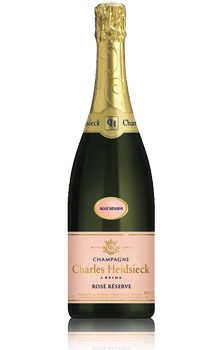
Charles Heidseick Rose Reserve NV

This is a great wine to go with you posh Valentine’s dinner. It has beautiful red berry aromatics of strawberry and raspberry and a creamy, silk-like texture on the palate packed with jammy fruits. The red wine in the blend (7%) comes from the great grand cru sites of Ambonnay and Bouzy, giving the blend enough power and intensity stand up to a rich lobster dishes or even lighter game dishes such as Guinea fowl.
Keep it English
Balfour Brut Rosé - £35.99 at Waitrose

This is arguably England’s finest sparkling rosé (though Nyetimber’s Brut Rose and the Gusbourne Estate Rose are fantastic too). It has beautiful stone fruit aromas with peach, nectarine and even a hint of marzipan on the palate. It’s a great aperitif and is very easy to get through a whole bottle with your partner.
On Special
Lanson Rosé NV - £17.99 at Tesco (usually £35.99)

This is £17.99 at Tesco until the 14th February and that makes it incredibly good value for money. If you are looking for the safety of a brand you know at great price then this is the champagne for you. Like the Lanson Brut NV, this champagne doesn’t go through malolactic fermentation and as a result has a racy acidity which is great with smoked salmon blinis and other oily fish dishes. It also has a pure raspberry flavours which would work with sour fruit based desserts like summer fruits and cream. 
Splash Out
Bollinger Grande Anne Rosé 2002 - £85 at Majestic

Quite simply, to my taste, this is the best rosé champagne out there and the 2002 is one of my top 5 champagnes of all time. It’s made exclusively from Grand (77%) and Premier cru (23%) juice and has around 7-8% red wine from La Cote Aux Enfants added to the blend. It has a pretty salmon pink colour and a forest floor charactor on the nose. It’s another full bodied champagne which works great with so many types of food. It is rich enough to stand up to venison with a blackberry jus or an earthy veal and mushroom dish. It also has a lifted fruit-driven finish, which cleanses your palate like no other wine on earth. Go on, treat yourself.

Sunday, 7 August 2011

To Decant or not to Decant?

For most people, even many champagne aficionados, the thought of decanting a champagne before they serve it would not even even cross their mind. Surely it will cause your prized champagne to lose all of its bubbles, wouldn't it? However, it is an interesting practice which seems to be gathering momentum recently, especially with the sommeliers in Paris. It's not as mad as you may think though, after all, it is a fine wine and you wouldn't dream of opening your favourite Bordeaux or Burgundy without allowing it to 'breathe' for an hour or two. Furthermore, the act of decanting doesn't actually cause a champagne to lose its bubbles as fast as you may think. Experts have worked out that a champagne will only lose 10-15% of its effervescence through the act of decanting. A word of warning though, you must take care when decanting your champagne, imagine you are trying to pour the perfect pint!

So, what can you actually gain from decanting a champagne? Like, with other wines, decanting champagne allows aromas in the wine to be released. This causes the champagne to become more fragrant and it can also dramatically change how your champagne tastes. Something which seems fresh and citrussy upon opening can give way to rich, earthy and all together more vinous flavours after just 10 minutes in a decanter (or even just left in a glass).

Charles Heidseick, one of my favourites of the big champagne houses, is a big advocate of decanting their champagnes. They have even teamed up with Riedel, the glassware giant, to produce a very elegant decanter. Billecart Salmon have also produced a limited edition decanter which some Searcys champagne bars in London will be using.


Decanting champagne is definitely worth a try. A fun experiment to try which I saw Jennifer Simonetti-Bryan , MV do on Wine Library TV is to open a bottle of champagne and decant half the bottle and leave to rest in the bottle with a champagne stopper in. Leave both for around 30 minutes and then do a side-by-side comparison. The differences between each samples are noticeable and dramatic.

Monday, 25 July 2011

Sushi and Champagne

Oysters and Chablis, steak and Malbec, lamb and Rioja. There are some classic food and wine pairings that, for whatever reason, work. For me, sushi and champagne is one of them. Now, classically in Japan sushi is eaten with beer or sake, the rice-based wine. Champagne and sake are very similar in that both are measured by their sugar levels. With sake the scale goes from +10 (very dry) to -10 (very sweet) but for champagne the scale goes from Brut Nature (very dry) to doux (very sweet). Many people think that sake should be served hot but actually the best sakes are served at room temperature or slightly chilled as heat causes many of the delicate aromas to be lost. 


Richard Geoffroy, Dom Perignon's Chef de Cave, suggests that Dom Perignon is a great partner to the Japanese cuisine because the high yeast content in champagne partners well with the high yeast content in soy sauce, a Japanese staple, but I feel it works on many other levels as well. It is a natural fact that champagne is a great partner for various fish dishes because of its high acidity and cleansing qualities. Most champagnes are also relatively light in their NV forms and so do not overbear light sushi dishes like ginger marinated tiger prawns and salmon nigiri. A favourite tried and tested pairing of mine is tempura salmon maki (infact most tempura dishes) with a light chardonnay dominated champagne, like the Ruinart Blanc de Blancs NV or, if you want something different but equally mouth-watering, the Colin Grand Cru 2004 from French Bubbles.

For heavier japanese dishes like teriyaki duck, I would suggest a more gutsy vintage or rose champagne. The salty character of dishes like this work well with the refreshing champagne nature. I would suggest Gosset Grand Millesime 2000 as a good partner. Its mature and honeyed with ripe, peachy fruit. The Charles Heidsieck Rose Reserve is another fleshy, gastronomic champagne that could hold its own with some heavier sushi dishes.


A word of warning though, strong flavours can kill even the richest champagnes and any heat clashes badly with acidity. This having been said...  go easy on the wasabi.

Wednesday, 1 June 2011

Remy Cointreau Group sell Piper-Heidsieck Compagnie Champenoise

Remy Cointreau Group have announced that they have sold Piper-Heidsieck Compagnie Champenoise to the family controlled group EPI for €412.2 million. EPI will take control of all of Pipers Champagne operations including Piper Heidsieck and Charles Heidsieck as well as Piper Sonoma, the sparkling wine brand from California. In a statement Christopher Descours, Chairman of EPI, stated: “EPI is very pleased to acquire both these prestigious champagne houses, that are Piper-Heidsieck and Charles Heidsieck. They perfectly complement our other French luxury goods brands, which include JM Weston, Alain Figaret and Bonpoint. This new initiative will strengthen our commitment to wine-making, initiated 20 years ago with Chateau La Verrerie (Lubéron.)”.